
We get lost approximately four times before we find it.
Our driver, we’ll call him Ngugi, is a man with a thick Kikuyu accent and the look to match. Google Maps is failing us, but Ngugi isn’t shy about asking for directions. He isn’t one of those with egos too fragile so we stop at every turn to ask the locals.
The drive is calm. The weather is warm, the sky a beautiful blue. We have no clue what awaits us at our destination. No idea who we’ll meet or what to expect.
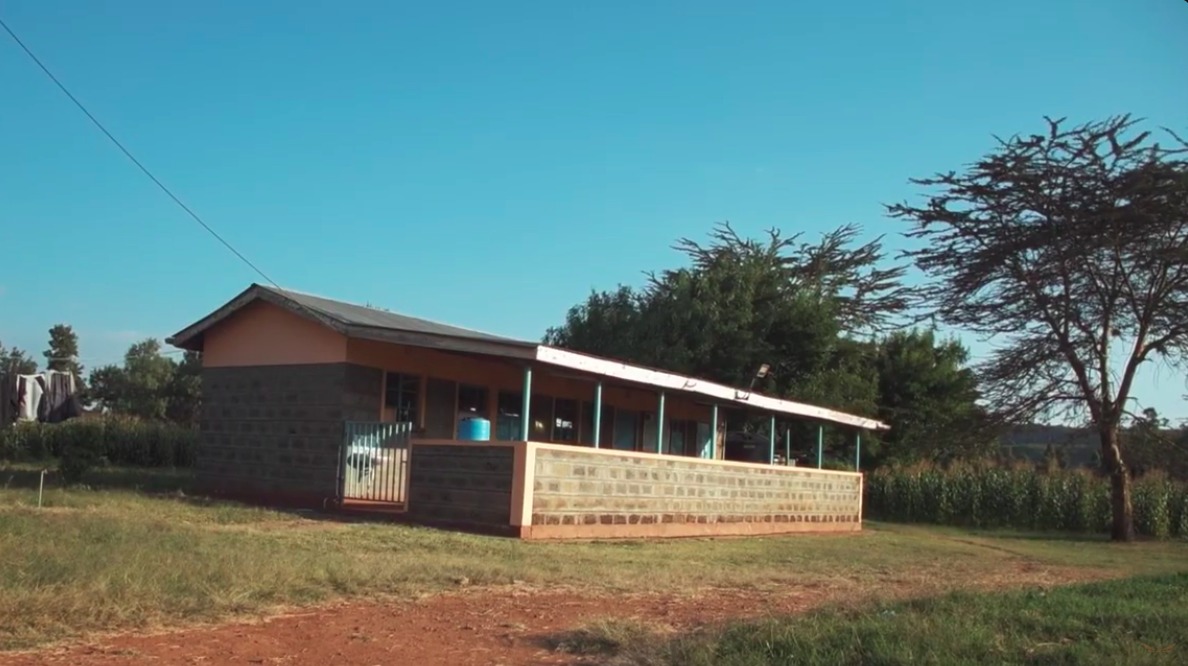
We finally find it. A little building sitting in plain sight which we must have passed once before. How did we miss it? As we drive in along a narrow path, naturally worn into the ground by passing traffic, we take it in. A little, single-storey building. Simple in design, similar to what we used to draw in Grade One when we were told to draw a house. Four walls. A roof. A window or two if you were feeling particularly adventurous. If I had to draw one right now, I can’t promise my taste or skill has changed very much.
This building isn’t much more intricate than any drawing I could conjure. Just four doors instead of one and a verandah with two wooden benches that serve as the waiting room. Simple. Modest.
We’re in the Nachu area of Kiambu, in Kikuyu Sub-County. The area is dry. The ground hasn’t had a decent drink of water in many months. The grass crunches beneath our feet, and the sun beats down on us with an intensity that seems to challenge us to spend another minute outside. There’s livestock grazing nearby, goats and sheep, each doing its best to find something to keep it alive.
At first sight, the place isn’t exactly impressive. Atleast not by city-bred standards. You’re not getting there and gasping at the architectural marvel before you. But there’s more to this little building than meets the eye.
We’re met by a warm, kind-faced, light-skinned young woman who introduces herself as Zipporah and welcomes us to the Nachu Level 2 health facility.
As it turns out, Zipporah is a nurse and the only licensed healthcare practitioner serving the dispensary and the surrounding area. Approximately 1,500 households rely on this facility for medical care. People travel from far and wide, including from the hilly areas surrounding this little patch of flat land.
I wonder if I would have the wherewithal to manage that kind of responsibility. Good thing a whole community is not dependent on me.
But Zipporah isn’t just kind-faced. She is kind.
She walks us through her day-to-day work. A typical eight-to-five job, five days a week, with the sole responsibility of treating everything from coughs to high blood pressure to injuries. She says she sees an average of 15 patients a day. Men, women and children, who make up about half of her usual patients.
“Most people travel from very far to get here. And many of them come on foot. This dispensary is a lifeline for people in the surrounding areas,” she says, pointing towards the hills.
She originally comes from Machakos, but the job brought her here 11 years ago, and she’s since planted roots.
“Has it been difficult, being here all these years, doing this work on your own?” I ask.
“Well, it’s not been easy, but I’ve had help occassionally.”
“Why have you stayed this long?”
“The community. It grows on you.”
I think back to my life in Nairobi and wonder whether we quite understand what she means when she talks about community.
She then takes us on a tour of the dispensary.
The first room is the triage room. It’s an adequately sized, square-shaped room. No windows. Green walls. A cluttered desk and two chairs. It has all the basics: a stethoscope, a thermometer, an otoscope, an ophthalmoscope, a blood pressure monitor, an adult weighing scale and a baby weighing scale, among other equipment. There’s also an SHA-issued mobile device and a biometric scanner.
Note the singular. They have one of each.
I ask about SHA and how, or whether, it works. She beams as she explains that it works pretty well.
“As long as you are registered with SHA, the treatment is free,” she explains.
She proudly demonstrates the point of care system that she uses daily, and we’re glad to see it in action.
She tells us that much of the equipment they have was donated by The Safaricom Foundation: baby weighing scales, a water dispenser, stethoscopes, a wheelchair, among other things. She’s grateful because the equipment has enabled her to provide much better care.
We move on to consultation rooms one and two, and then the pharmacy. They follow the same simple design as the triage room, each equipped with what is needed. The pharmacy is reasonably well stocked, and I can tell that she’s content with what they have and grateful for what they’ve received.
Zipporah tells us that, until last year, there was no proper road leading to the dispensary. I think back to how we got here: a full stretch of tarmac, pretty much all the way.
For the decade before that, patients had to find their way to the dispensary along poor roads. But still, they came. Because when you need medical attention, you find a way.
And then we get to meet a 76-year-old force of nature. Let’s call her Wairimu.
Wairimu is about five feet tall, slightly hunched over from years of being a pillar in her community and carrying its weight on her shoulders. She’s dressed in her Sunday best, a green kitenge that is a familiar sight in Kenya. She walks with a stick, which almost seems like an accessory. It’s the only reminder that she isn’t the young, sprightly woman her personality might have you believe she is.
She’s just come from her chama cha wamama, where she serves as chairlady. It’s a group of 20 women who meet weekly to discuss everything and anything under the sun. Oh, what I would give to be a fly on the wall at one of those meetings.
It is worth noting that all 20 women are widows. Do with that what you will.
Wairimu begins telling us the history of the dispensary. Long before this solid structure stood here, recognised by the government as a Level 2 health facility, there was a simple mabati structure established by members of the community.
They sourced medicines from donors, and this little structure became the distribution point.
Back then, in the 1980s and 1990s, Wairimu was a CHV (Community Health Volunteer), long before the role was formally established and the phrase coined. She would walk long distances to people’s homes, initially delivering medicines to those who couldn’t make their way to the distribution point. Over time, she began offering medical assistance wherever she could. Not because she was trained, but because she wanted to help people who were suffering and who came to her for help.
When people brought her their health concerns, she would seek guidance on how best to help them. Somewhere along the way, she received training at hospitals so she could serve her community better.
She went as far as becoming a midwife, delivering countless babies in people’s homes and at the dispensary. She even delivered two of her thirteen grandchildren herself, at home.
She’s a jolly woman with a personality that has me forgetting her age. Her face carries the contentment of a life well lived. She has a wonderful sense of humour and a generous dose of charisma.
She tells us how grateful she and the rest of the community are to have a functional dispensary, and how much it has helped alleviate their suffering.
She herself comes here every week to receive treatment for her high blood pressure. She explains that her swollen leg is related to the condition and Zipporah helps her manage it. It makes me smile that the woman who has spent so many years caring for her community now has someone here to care for her, too.
After a long, inspiring conversation and a full history lesson, we begin to appreciate just how deeply Zipporah and Wairimu’s lives are intertwined with the history and wellbeing of their community. Eventually, it’s time to say our goodbyes and make our way back.
I leave in awe of many things. Women, for starters, and what they can mean to a community. I’m struck by what people can accomplish when they take responsibility for one another, often with little to no recognition.
The community didn’t wait for the government to establish a facility before doing something about its healthcare needs. Wairimu, the little mabati structure that preceded this dispensary, and Zipporah are all reminders that people were already doing the work long before the resources and formal recognition arrived.
I’m glad to see that Safaricom, through their foundation, isa playing a part in supporting this and many other community through their local medical centers. According to Zipporah, the equipment donated to Nachu Dispensary has made a real difference in her ability to serve the people of Nachu.
For the rest of the day, I can’t help thinking; what if public resources were allocated and spent effectively? What if the people already willing to do the work weren’t constantly having to compensate for institutional failures? How much further would we be?
I’m not suggesting that a stethoscope will fix our healthcare system or that a generous donation can undo years of mismanagement. But standing in that little dispensary, seeing what a few pieces of equipment and a little support have made possible, I can’t help thinking about how much potential we leave untapped when the resources meant to serve us fail to reach the people who need them.
Zipporah and Wairimu are two women in one community in Kiambu. There are more people like them scattered across this country, doing the work, making a difference, and often going unrecognised.
These are the real heroes.
They deserve our admiration, yes. But more than that, they deserve our support.
This story also lives on Substack. Read it there ↗
Enjoyed this read? Show Muthoni some love.
Leave a comment before you go 🙂