
The Lucky Ones
At 73, he still looks like someone’s son.
He stands straight at about 6’4”. Bright smile. Wide, wise eyes. Skin smooth as a baby’s butt. (No dummy! I didn’t touch. But my eyes can feel smooth skin. Can’t yours?)
He calls himself “The Blackest Man in Africa.”
Hardly.
“I host Rogaroga every Saturday and Sunday, 10am–1pm, on Citizen Radio,” he says.
Everyone at the table knows this.
Except me.
I marvel at this way of retirement.
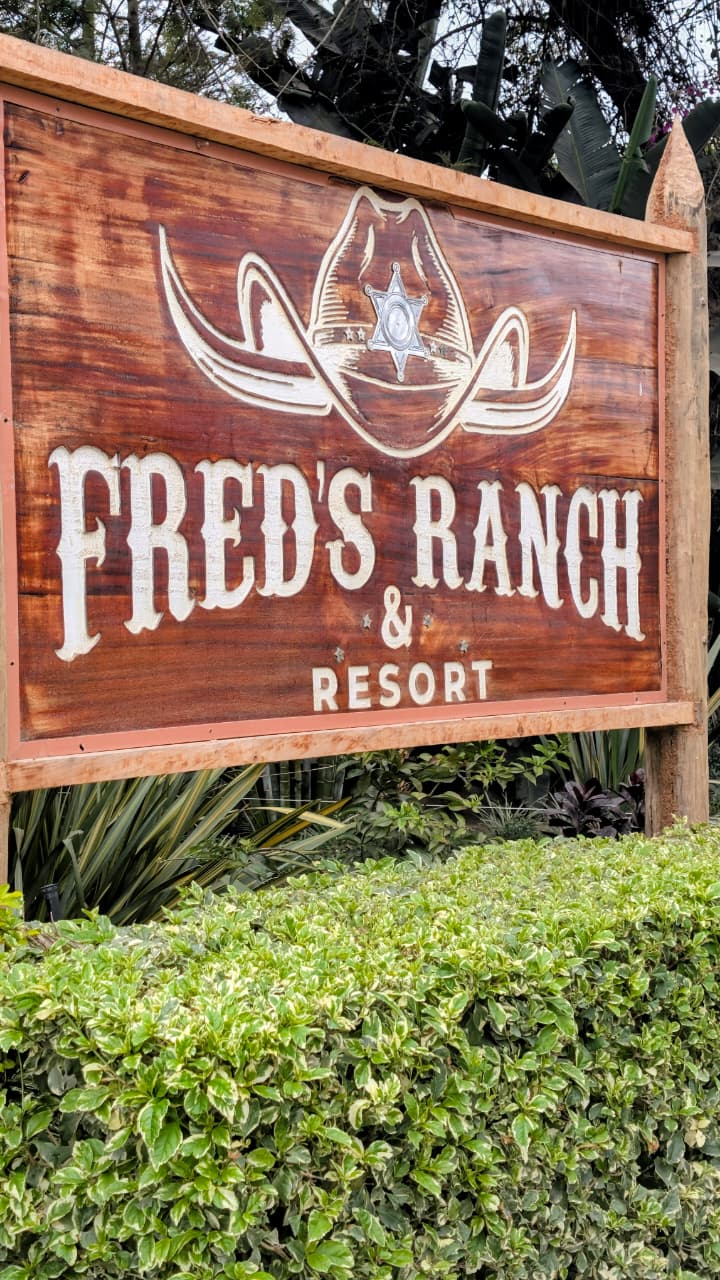
I have observed him around his farm at the famous Fred’s Ranch. He loves it. He walks around in his branded cowboy hat “looking important,” he quips. As though the ranch itself has appointed him chairman of everything.
Sharp mind. Even sharper humour.
“So this is retirement?” I ask.
For 50 years, since joining Voice of Kenya in 1976, Fred has been a household name. Twenty-six years at VoK, now KBC, followed by his move to Citizen Radio and Royal Media Services, where he remains to date.
His career is the kind that can be summarized in numbers: five decades, generations of listeners, thousands of broadcasts, a voice people recognize before they even know where it is coming from.
But the career fascinates me less than the man sitting before me.
Beyond the millions who have grown up listening to that distinct, deep voice. Beyond the nostalgia and the decades of broadcasting, there is simply a man.
And that is the man I am interested in.
There is something about him that feels old in the best possible way. The kind of wisdom you don’t learn from books. The kind accumulated by lived experience.
I want to drink from that fountain.
“Retire? From what?” he responds.
Confusion at first, then I smile. I think I know where he is going with this, but my eyes prod him to explain further.
“When you love what you do, you never work a day in your life. It’s like getting paid to go to the movies.”
What a concept.
Of course, this is no new concept. The internet has been serving us variations of the same idea for years: “don’t love your job, job your love.”
Easy to repost.
Much harder to live.
Fred, however, is seated in front of me at 73, having apparently taken the quote literally.
I space out to internalize this.
There are four of us at the table.
Two of us work jobs.
Two of us, apparently, will never retire.
Fred is one.
The other writes.
Words I wish I could make love to.
Later, as we leave Fred’s Ranch, I turn to number two.
“Do you think you will ever stop writing?”
He is driving. He looks at me perplexed, maybe at the foolishness of my question.
“I will write until I die.”
I smile.
That’s his retirement plan.
Rather, that’s his life plan.
Because perhaps that is the difference.
Most of us imagine life as a sequence: school, work, earn, save, retire, and then finally – live.
Fred seems to have skipped to the last step 50 years ago. Number two, 20 years ago. Because for them, the living has been happening inside the work.
And suddenly retirement is a foreign concept.
Why would you retire from something you would do even if nobody were paying you?
I don’t think we realize how lucky these people are.
The ones who can “job their love.”
Then there’s the rest of us.
The engineers. The accountants. The lawyers. The doctors. The project managers. The developers. The corporate consultants. The people with increasingly impressive titles and increasingly impressive LinkedIn profiles.
The people who go to work because Monday came.
I know this world well. You likely do too. And for the rest of this article, perhaps my “I” can be yours.
I am good at what I do.
Let me drop the modesty: I am great at what I do.
It is one of those things you tell people you do and watch them become impressed. Because it is for “smart people.” And because I am, in fact, smart, I do it well.
I solve problems. I build things. I make decisions. I can sit in a room full of complicated things and usually figure out how they fit together.
And I am proud of that.
But somewhere along the way, I begin to wonder whether competence is enough.
Because being good at something and loving something are two very different things.
And perhaps this is one of the traps of being capable.
When you are good at something, the world rewards you for it.
People praise you. Promote you. Pay you. Give you impressive titles. Tell you that you are lucky.
And you are.
So you stay.
Why wouldn’t you?
Why would you walk away from something you are successful at?
But just because you can do something well, does it mean you should do it for the rest of your life?
Maybe being rewarded for something is not the same as being nourished by it.
What if the very qualities that make you successful – discipline, intelligence, ambition, resilience – can also keep you somewhere long after your soul has started asking to leave?
We are very good at asking children what they want to be when they grow up.
We are less good at asking adults whether the thing they became is still the thing they want to be.
And maybe that is because the second question is much harder.
It is easy to build a career.
Harder to build a life.
Maybe work should do more than pay the bills and prove that you are competent.
Maybe it should give you something back.
Curiosity. Joy. Meaning. Expression. Connection. A sense that the hours you spend doing it are not simply hours you are exchanging for money.
Something that makes you say, at 73, “Retire? From what?”
I don’t know what that thing is for me yet.
I know what I’m good at.
I know what I’m capable of.
I know how to succeed.
But Fred has made me wonder whether those are the questions I should be asking.
Perhaps the better question is:
What is the thing I could do till I die?
The thing that would still feel worth doing when the titles no longer matter. When the promotions stop. When nobody is impressed by my CV.
The thing I would keep doing because I couldn’t imagine not doing it.
The thing I will never retire from.
These are the lucky ones.
The people who, like Fred, don’t have to dream about retirement because they never built a life they needed to escape from.
And perhaps for me, this is where the search begins.
This story also lives on Substack. Read it there ↗
Enjoyed this read? Show Muthoni some love.
Leave a comment before you go 🙂