
The Odyssey was a very well-marketed movie.
So well marketed, in fact, that it was marked on my calendar. And I’m not even the mark-it-on-the-calendar type.
I’m crazy about medieval movies. Give me dramatic costumes, people riding horses through mist, unnecessarily large swords and somebody screaming about honour, and I’m sold.
So off I went. Only to discover that IMAX cinemas across the country had run out of caramel popcorn.
What’s a good movie without caramel popcorn?
I sat through three hours of The Odyssey with normal-person caramel for company.
Maybe it was the disappointment of the popcorn talking, but when I saw Anne Hathaway’s acting, I wanted to punch her through the screen. Tom was good. Matt was good too. Lupita… hmm.
Robert Pattinson phenomenal. Absolutely ate up that role. I wanted to punch him also, but for different reasons. He delivered.
Sometimes I think we’re losing the art of real acting. Modern cinema can do extraordinary things. Cinematography can transport you. CGI can put entire worlds on a screen. Editing can stitch together the perfect performance from a hundred takes.
But doesn’t spectacle only work when there is a human being underneath it who can make you believe?
Anyway, this is not an article about movies.
A while after my three-hour caramel-related disappointment, I find myself sitting in the darkened Jain Bhavan auditorium in Loresho. Its 800 seats sparsely populated with experts hard at work. Production managers, light and sound engineers, writers, director. The stage is massive, begging to be consumed.
It’s day one of tech week. For the uninitiated, tech week is when the theatre moves into the actual performance space and starts putting all the pieces together: lights, sound, positions, props, movement, timing, the whole thing.
Today, there’s a tree setup here, a few logs there, and some brown bags at the back, presumably filled with sand, representing trees yet to be planted. Pieces of a world being built around us, slowly giving Wangari Maathai’s story room to breathe.
It’s a sparse setup. Nothing like what the real thing will be but the building work has begun.
The lights are controlled, moving between characters and scenes. And the only sounds to be heard are the voices of actors, who all believe that “Good acting is in fact not acting at all,” to quote Marichu, production manager of the show.
“See, the difference between a movie and a play is that a movie is made up of many perfect scenes and cuts. A play is one continuous performance. No retakes. No ‘CUT’ because you messed up a line. You get one shot, in front of a live audience,” Abigail Arunga says.
Seems obvious, huh? But I never thought of it this way.
A movie can hide its seams.
A play can’t.
A movie can cut away.
A play can’t.
A movie can retake a scene until everybody gets it right.
A play asks you to get it right now, in front of 800 people. Over and over again for three days.
And suddenly that enormous empty auditorium felt very different.
There is nowhere to hide.
No CGI to rescue you.
No clever camera angle.
No edit.
No second take.
Just bare human beings standing on a stage, tasked with making hundreds of people believe.
Anisa Akinyi makes it look unfairly easy. It’s giving reincarnation. She delivers Wangari Maathai so convincingly that, at some point, I turn to Abi.
“Does she actually speak like this?” I ask, referring to Anisa in character.
“Yes.”
“Really?”
I turn back to the stage, genuinely impressed. Wow. What are the odds that they found someone who speaks exactly like Wangari Maathai? Damn. Must be something in the stars.
“No, dumbass! She’s acting,” Abigail chuckles, rolling her eyes.
Oh.
I feel dumb. But honestly, who can blame me?
The acting is that good.
And then there’s Red Brenda, who has the energy of a wild rabbit that’s just discovered caffeine. She is tiny but packs a hell of a punch. The moment she hits the stage, it’s hers. She throws attitude, charisma, energy and mad talent at you like it’s a renewable resource. You can’t look away. Why would you?
And the energy doesn’t switch off when they leave the stage. They’re all buzzing with what I can only describe as some kind of electricity. KPLC could harness it, power the country, and there’d still be plenty left over.
What I get to witness on this day is a stripped-down version of the show. No dramatic sound effects, or music, or lighting setup, or props. Just raw performance. Nine actors backed by a supporting team of a hundred plus, who’ve spent countless hours perfecting their performances.
And they were good.
They were very good.
While it was a cold day in Nairobi, even colder in Loresho – because trees, guys, trees! – nothing was enough to give me goosebumps like the performance I was about to watch over the next couple of hours.
It wasn’t a recital.
It was emotion.
It was heart and soul on a stage.
Immersive even before the production is finished.
Committed even without an audience.
Passionate.
Pure art.
And while the actors breathe life into the performance, you can’t inject a pulse to a dead script. The script is the backbone.
And the writing on this one takes the crown.
It’s packed with humour, wit, historical adages and references, modern language, memorable characters, clever turns of phrase and enough surprises to keep you thoroughly entertained.
But it has substance too.
The sheer amount of research that went into telling the story of Dr. Maathai is evident. A woman who was not merely a witness to Kenya’s history, but a participant in it. Environmentalist. Academic. Women’s rights advocate. Political activist. Parliamentarian. Nobel Peace Laureate.
A woman who fought to keep Uhuru Park from being turned into a skyscraper and stood up to a government that was not fond of being challenged.
A woman who fought for democracy, human rights and the environment.
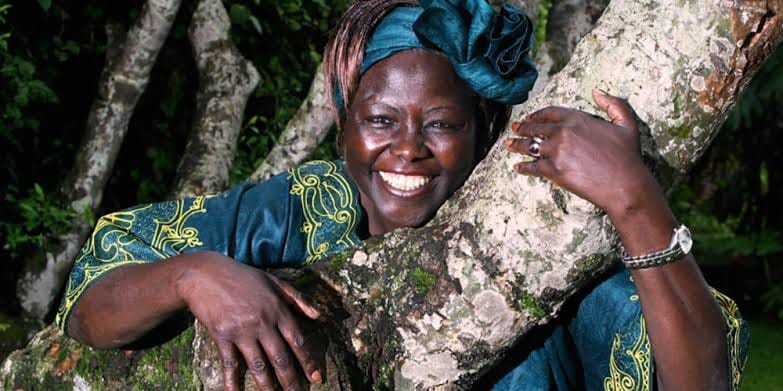
A woman who hugs trees.
Dr. Wangari Maathai before she was “shawty-for-trees,” as she’s now affectionately known on the streets of social media.
The 3-hour show spills all the tea: Political movements. Betrayals. Successes. Marital and family life.
It is a show about the making of a force. An inspiration of a woman. Homegrown.
And not once does this feel like a history lecture. Frankly, if Kenyan and African history had been taught to us like this in school, we might have paid attention. Maybe our trajectory as a people would be different.
In case you haven’t caught on yet, this is an article about plays. One play in particular. About one woman. Dr. Wangari Maathai.
It is a recommendation, a decree even, that you must watch this play.
It is currently on a rerun. The first run happened in April. I missed it because I was probably hunched over the glowing rectangle, replying to an email that felt like life or death, while a remarkable retelling of one of the most important chapters of our country’s history was happening somewhere else.
Due to popular demand, it is back in theatre. And I wouldn’t miss it for the world.
Because sure, I could go watch a movie on that first date.
Where I’d spend 2.5 of the 3-hour date sitting beside this person I am supposedly trying to get to know, while getting emotionally acquainted with people inside a screen. And when we finally emerge from the cinema, he’d ask, “So…what do you do for fun?”
Wow. Just wow.
But every so often, we get a chance to immerse ourselves in a different world – one that educates, entertains and inspires, and in the midst of it all, breathes a little soul back into our own lives.
If you aren’t convinced yet, here are 10 reasons you should watch this show:
- Nobody will run out of caramel popcorn on you. Mostly because there is no caramel popcorn. But you won’t miss it, I promise.
- Your “High Importance” emails will still be there on your return. The retelling of Dr. Maathai’s story might not be.
- Your phone’s screen time report could use a break. Three hours of not looking at a glowing rectangle? Growth.
- I’m willing to bet you don’t know the origin of Jomo Kenyatta’s name.
- I’m willing to double down on that bet and say you don’t know how Wangari Maathai got her name.
- After this, you get to be that insufferable cousin at the next family gathering, correcting your uncles about Kenyan history and winning at ‘Kenya at 50’.
- If you must take her somewhere, creative points for choosing an immersive play over a movie. And you’ll actually have something to talk about afterwards. (But please, for the love of goodness, don’t finish the play and ask her what she does for fun.)
- You’ll be getting all the country’s tea. So much tea! And I know you like tea.
- Your man isn’t making you laugh? Leave him. Abigail Arunga’s got you covered. Bring the girls.
- Sure, Tom Holland can act. But can he bring to life the woman who stood up to the government to protect our Uhuru Park?
Too Early for Birds: Wangarĩ Maathai – Edition 9. Shawry for Trees: The Roots of a revolutionary. September 25–27, 2026. C.U. Shah Jain Bhavan, Loresho, Nairobi
Grab a seat here.
This one is marked on my calendar.
And one of those 800 seats has my name on it. Maybe the one next to it has yours.
Bring me some caramel popcorn, we’ll sneak it in somehow.
Then, when it’s over and you realise I spoke nothing but gospel truth, come back and leave a “You were right!” in the comments.
And don’t be like the 10 lepers who were healed by Jesus and only one came back to say thank you.
I’m not saying I’m Jesus.
But be the one. 🙂
This story also lives on Substack. Read it there ↗
Enjoyed this read? Show Muthoni some love.
Leave a comment before you go 🙂