
I drove home in silence that night.
Not ready to let reality back in just yet. I wanted to sit with everything the evening had stirred up and let it unravel me.
I wanted to change careers. I wanted to stop right there and stand up for something. Begin a protest at 11:52pm in the dead of night. A protest about anything. Trees. Corruption. Greed. Bad leadership. Bad roads. 5 day work weeks. KFC.
I wanted to be a nuisance.
How did I get here?
A few hours earlier, at 4:45pm, I had arrived at the venue for a show was set to start at 7pm. I am not widely known as a timekeeper, but two things about me are true: One, I despise traffic and I’ll do anything to beat it. And two, I wasn’t missing a minute of this show.
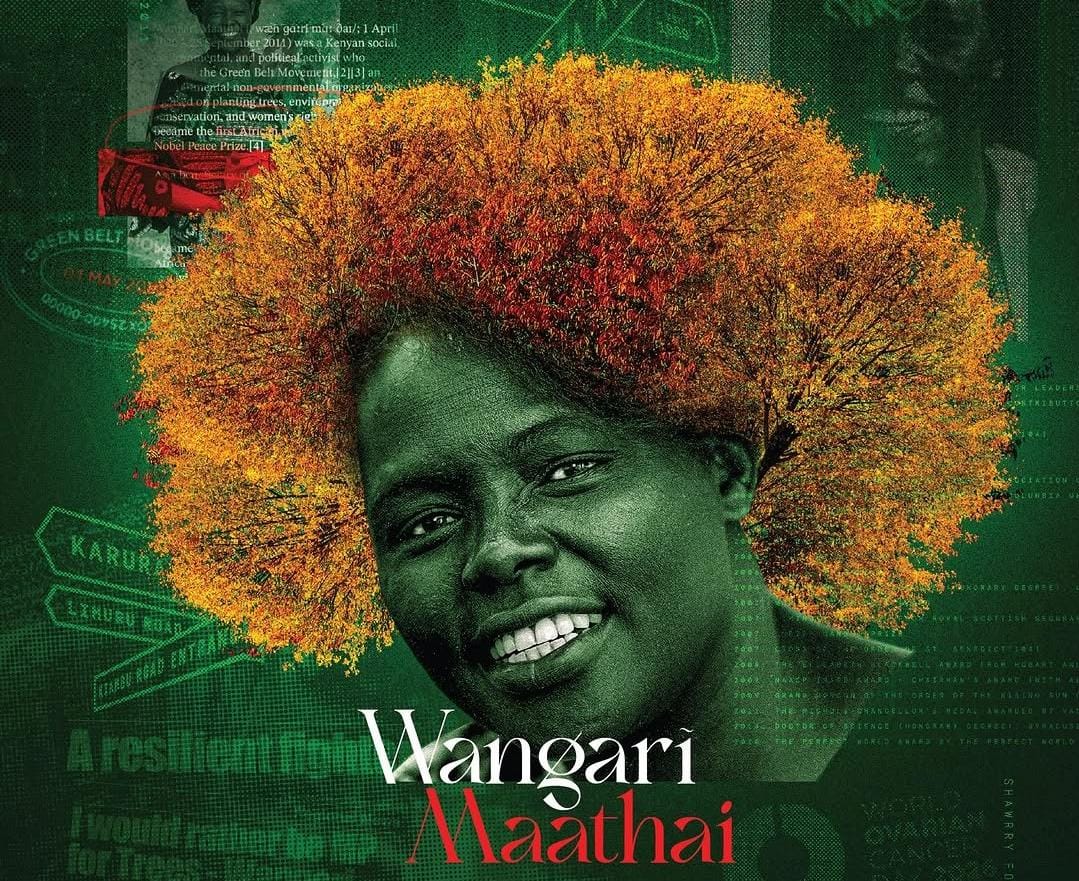
I walked into the Jain Bhavan auditorium and found that tech week had done its job. Wangari Maathai’s Shawry for Trees was ready to take the stage. The stage backdrop was in keeping with the theme, a forest. Long, wide, old trees stretching across it, the kind that look like they’ve been standing there for centuries. It would get even more beautiful as the light danced across them, giving the forest a different life each time.
Walk into certain corporate spaces and, if you’re lucky, you meet a few humans. For the most part, though, you meet robots. Humans who, through no fault of their own, have had to strip their personalities down to the bare minimum in order to be acceptable. Voices hushed. Laughter measured. Dress safe. Expression restrained. Everything just…contained. The air itself feels stifled.
Not here. Here, the air flowed like it does on the windward side of Mount Kenya.
The energy was unrestrained. People existing wholly. Loud laughter. Free movement. Strangers chatting like old friends. People entirely comfortable taking up space. Full of life. Full of themselves. Full of each other.
Maybe for the artists, it’s part of the job. Maybe you have to exist bare to make art like this. No walls. Your whole self has to come to work.
There is a surprisingly niche audience here. Lots of white folk and a particular brand of Kenyan, the kind who might support protests from behind desks. These ones too, if well motivated, can move mountains.
In any case, the room is alive and I’m here for it.
I spent the next two hours expanding my world and speaking to the talent behind the making of the show.
Ngartia, aka Maandamano volunteer as Truecaller has him registered, is the Research & Development Lead. He has a smile bright enough to light up any cave, with locks twisted and falling freely across his face. There’s something about his ease, his laughter, the way he carries himself that makes me imagine a similar kind of freedom happening inside him. Together with Anita Murage and the rest of the research team, they did an incredible job, bringing the intricacies of Wangari’s life to the story with remarkable detail.
Abigail Arunga, the play’s lead writer, is here too, dressed in green and looking every bit the star she is, perfectly on theme and in honour of our lady, Wangari. Abi floats around the room, chatting, laughing, seemingly never in one place for more than 12 seconds. A little social butterfly, though I suspect she’d reject this allegation.
I also get to meet the director, Martin Kigondu. He has the air of someone who could sit through a storm, lightning striking all around him, and somehow manage to guide the way through the chaos without becoming part of the frenzy.
I realise as I speak to him that I don’t quite know what a director does. I mean, do you? Sema tu ukweli.
This feels like a good time to expose my ignorance, “So what does being a director actually involve? What does the day-to-day look like?” I ask.
He mulls it over for a moment, probably wondering how to condense an entire job into a few sentences. “Well, I’d say the heart of the role is in bringing everything together and bringing the story to life. Working with the writers, getting the best out of the cast, shaping the scenes and all the visual elements. Taking the different pieces and making them work together as one to create something the audience can feel.”
Ah. I see it now.
I proceed to bombard him with questions because it is not often, when writing code, that I get to meet directors willing to patiently indulge my bottomless curiosity about the day-to-day of their job.
I learn many things from that conversation. But more than anything, it is his enthusiasm and interest in discussing the details of the work that gives away the passion.
It seems to be a golden thread here, that passion.
And when the show begins promptly at 7pm, that passion is impossible to miss. It screams at you from the stage.
We are seated and ready to be transported away from our realities. Except the show never quite lets us leave them.
It is a play, of course, made to entertain. To take us into another time, another story, another person’s life. But woven through it all are reminders of the reality outside those doors. The references are constant. Wangari’s fights begin to feel eerily familiar.
They take us through the journey of Wangari’s childhood, her early education, her Christianity and faith. Her journey abroad to further her education. Her exposure to a new world, a different way of thinking. A first-world nation that broadened her worldview and altered her understanding of what was possible while deepening her appreciation for the richness and potential of the land she had left behind. Then her return home. Her marriage. And eventually, the becoming of the Wangari Maathai we know today.
The woman who chose a hill and was willing to die on it.
A seemingly simple cause for a woman with a PhD.
Trees.
Plant trees and restore the forests. What could possibly be political about that?
Everything, as it turned out.
What began in 1977 with Wangari planting nine trees in her backyard became the Green Belt Movement. She mobilised rural women to plant trees, beginning with something as basic as restoring the environment around them, but quickly discovering that the roots of the problem ran much deeper. Deforestation. Poverty. Food insecurity. Land disputes. Disempowerment. And eventually, democracy and human rights.
More than 30 million trees had been planted through the movement by the time she received the Nobel Peace Prize, with over 50 million planted today.
She picked a cause and stood for it. Defended it. Wrote letters for it. Protested for it. Challenged power for it. Was arrested for it. Took beatings for it. And still she kept going.
She had an internal compass that seemed impossible to shake.
That internal compass turned into a national movement that mobilised women across Kenya, planted millions of trees, challenged environmental destruction, confronted political power and eventually carried her all the way to the Nobel Peace Prize.
The power of one woman who simply refused to let fear win.
That is a hell of a life to fit into three hours of theatre.
But they pull it off. The performance does justice to Wangari.
Akinyi Oluoch and Red Brenda carry Wangari across two different stages of her life, and both do it beautifully. Akinyi has moments where you forget you are watching an actor and simply watch Wangari. Then there’s the rest of the ensemble – Shiviske Shivisi, Diya Vaya, Sam Arlcons, Charles Gachanja, Joe Kinyua, Karimi Rimbui and Miss Kahiro. The cast moves through character after character, changing voice, posture, energy and expression so completely that each new person arrives feeling like an entirely different human being.
Miss Kahiro brings a particular kind of mischief to the stage. She pulls you out of the emotional depths just when you think you’re about to drown in them, sending the whole room into laughter before dropping us right back into the story.
The impact on the audience is palpable. We are transported through this world together. The collective silence, then laughter, then applause. The enthusiastic audience participation when called for.
We’re sold. We believe.
Then there’s the storytelling, which is brutal in its honesty. This is a room of different races and nationalities, watching a story that speaks plainly about colonialism, slavery, stolen resources, the stripping away of power and dignity. There is no awkward attempt to soften it. No tiptoeing around anyone’s feelings. You sit there and you take it. The things we like to think belong safely in the past, while recognising their echoes in the present.
It doesn’t stop at what was done to us. It turns around and asks us to look at ourselves too. To borrow Sauti Sol’s words: “Tujiangalie”.
Corruption. Greed. Silence. Complicity.
The politician in the room feels it. Anyone benefiting from the system feels it. All of us who have learned to look away, we feel it.
No one is spared.
When the show ends, three unforgettable hours later, I am planted to my seat.
I want to take it in. I want to stay in that moment. In that room. In that energy. I don’t want it to end.
And looking around, I can see I am not alone.
As I drive home, in silence, listening only to my thoughts, I am flooded with emotion.
I am inspired. Restless. Unsettled. I want to do something. Anything. I want to pick a cause and run with it. I want to find a thing that is wrong and become so irritatingly persistent about it that someone, somewhere, eventually has to pay attention.
I want to do more things that matter. I want to write letters. I want to ask uncomfortable questions. I want to walk into rooms and say, “No. This is not okay.” I want, in some small way, to channel the little Wangari Maathai in me.
Because the more I think about her life, the more I realise that her story was not really about becoming a revolutionary. It was about seeing the wrong and refusing to look away, and then doing something about it.
Then doing it again. And again. And again.
Maybe that is where the real work is. Not in becoming extraordinary but in refusing to become comfortable with wrong.
And somewhere between Uhuru Park, millions of trees, a room full of people, and three hours of being reminded exactly what one woman can do, I arrive at my takeaway:
As Wangari – whose name means “from the leopard” (wa ngarĩ) – aptly put it: “BE A NUISANCE!”
See, we have become very good at swallowing things we know are wrong.
The woman in the matatu complains about the dangerous driving and everyone else stays quiet because it’s easier. Someone is bullied at work, everyone knows it, but nobody wants to be the one who says something. We see corruption, dishonesty, cruelty, injustice and learn to live around it.
We call it keeping the peace.
Sometimes, many times, most times, if we’re honest, it is fear.
And justifiably so. Who wants to lose their source of livelihood because they said something? Who wants to be labelled difficult? Who wants to make an enemy of the person who controls their next opportunity? Who wants to stand out while everyone else sits quietly?
To be a nuisance requires courage. Not in the sense of an absence of fear, but a willingness to rock the boat for the sake of what is right, despite the fear.
To be a nuisance not only when the injustice is big enough to make the news or spark a protest.
To be a nuisance at home. At school. At work. In the matatu. In the supermarket queue. In the boardroom. In the relationship. Wherever something is wrong and everyone has decided it is easier to keep quiet.
To be a nuisance must be a lifestyle.
Yes, the fear is real. The consequences can be real too. But perhaps that is exactly why we need more of us willing to be nuisances. Because one person standing alone is easy to silence. It gets harder when there are ten. Harder still when there are a hundred.
Wangari did not build the Green Belt Movement alone. People gathered around the cause. Women planted trees. Communities joined in. Friends and family stood with her. Ordinary people took up the fight and made it bigger than one woman could ever have made it alone.
All it takes is for one person to decide not to look away.
Then another.
Then another.
Until the nuisance becomes a movement.
So yes.
BE A FREAKING NUISANCE.
This story also lives on Substack. Read it there ↗
Enjoyed this read? Show Muthoni some love.
Leave a comment before you go 🙂